

Direct answer
What small-business owners need to know
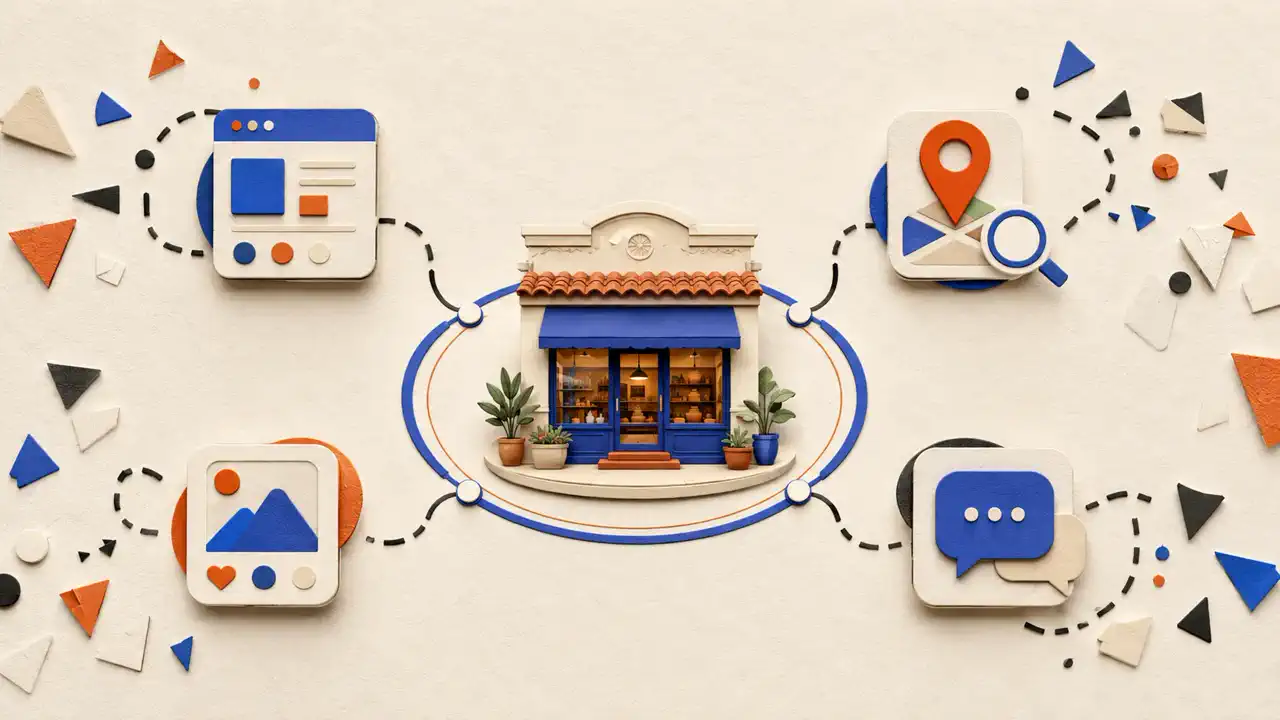
Most small businesses are not invisible because their service is weak. They are invisible because Google and customers cannot find one consistent, credible version of the business across a website, Business Profile, social pages and contact channels.
Key takeaways
- Customers need consistent business information before they trust a local provider.
- A social profile alone is not a durable digital foundation.
- Website, Google and WhatsApp should guide one connected customer journey.
- Ownership, measurement and regular updates matter after launch.
The real digitalization gap for Karnataka SMBs
Short answer: The gap is not simply the absence of technology; it is the absence of a connected and trustworthy customer journey.
A clinic, salon, shop, homestay or professional service may be respected locally yet appear uncertain online. A customer hears the name, searches on Google, checks the map, opens Instagram and looks for a phone number or WhatsApp button. Every mismatch creates hesitation.
For a small business, digitalization should make common customer actions easier: understand the service, confirm location and credibility, compare options and contact the owner. Software that does not improve those actions is not the first priority.
- No owned website
- Incomplete Google information
- Different phone numbers or addresses
- Inactive social profiles
- No clear next action
Six pain points that quietly reduce enquiries
The first pain point is discoverability: the business does not have a page that clearly matches what a customer searches. The second is trust: there is no current website, proof of location, service detail or ownership information.
The third is fragmentation. One vendor controls the domain, another created a social page and nobody knows who owns the login. The fourth is content delay—photos, prices and service descriptions are never approved. The fifth is mobile friction, and the sixth is the lack of measurement after launch.
- Search relevance
- Local trust
- Disconnected vendors
- Content bottlenecks
- Mobile usability
- No analytics
A five-layer digital foundation
Short answer: Start with identity, an owned website, local discovery, direct contact and measurement—in that order.
Identity means one business name, category, address, phone number and service description. The website becomes the owned source of truth. Google Business Profile supports local discovery; social channels provide activity and familiarity; WhatsApp and phone links convert interest into a conversation.
Analytics and Search Console then show which pages earn impressions, clicks and enquiries. This sequence is easier to manage than launching many disconnected tools at once.
- Consistent identity
- Owned website
- Google presence
- Social proof
- Calls and WhatsApp
- Measurement
What to prepare before hiring a website team
Speed depends on preparation. Nominate one decision-maker and approve the business name, services, prices, location, phone number, email, logo and photographs before the build begins.
Write down what customers ask every week. Those questions should shape service pages and FAQs because they reflect real buying intent in Kannada, Kanglish and English—not keywords invented in a spreadsheet.
- Business details
- Service list
- Approved pricing
- Logo and photos
- Frequently asked questions
- One decision-maker
How to measure whether digitalization is working
Short answer: Measure qualified discovery and enquiries, not follower count alone.
Track branded searches, service-and-city impressions, website clicks from Google Business Profile, phone calls, WhatsApp conversations and completed enquiries. Review the data monthly and improve pages that receive impressions but few clicks.
Digitalization is successful when customers find accurate information faster and the owner can maintain the system without losing control of the domain, code or accounts.
People also ask
Frequently asked questions
What is digitalization for a small business?
It is the practical use of owned websites, accurate local listings, social channels, direct contact tools and measurement to make the business easier to find, trust and contact.
Does every small business need an app?
No. Most local businesses should first fix their website, Google Business Profile, mobile contact journey and ownership. An app is useful only when repeated customer tasks justify it.
Can Instagram replace a business website?
Instagram can support discovery and proof of activity, but the platform controls the account and format. An owned website gives the business a stable source of truth and searchable service pages.
Apply this to your business
Need a connected website, Google and social launch?
Tell MyDesignNexus your industry, location and current digital problem. We will confirm the right next step and scope before booking.
Discuss my business ↗